What the app actually does
A complete list, without marketing adjectives. If something is not here, the app does not do it.
The solver
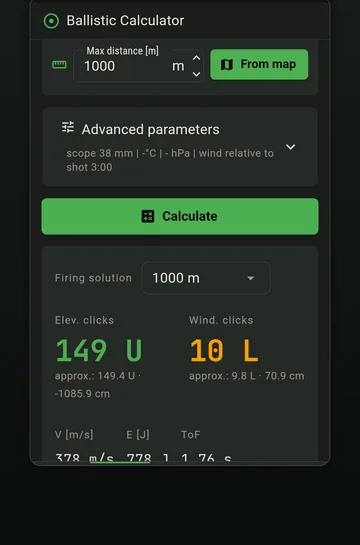
A point-mass trajectory integrated numerically with a fourth-order Runge-Kutta scheme against the ICAO G1 and G7 drag tables. That is the same class of model used by commercial ballistic software; what separates good output from bad is the quality of the inputs, not the integrator.
| Output | Per distance |
|---|---|
| Drop | In cm/inches and as an angular correction |
| Wind drift | By clock position, with head and tail components applied |
| Retained velocity | The best indicator of whether the prediction is still reliable |
| Energy | Kinetic energy at impact |
| Time of flight | How long the wind has to act, and the target has to move |
| Supersonic flag | Whether the bullet is still comfortably above the speed of sound |
| Spin drift | Gyroscopic drift, from twist rate and direction |
| Coriolis | Horizontal and vertical components, from latitude and azimuth |
Corrections for shot angle (uphill and downhill), rifle cant and powder temperature sensitivity are applied on top, and each is switchable so you can see what it contributes.
Ammunition data
- 1,600+ factory loads across pistol, rifle, magnum and hunting calibres.
- G1 and G7 coefficients where the manufacturer publishes both, with the preferred model marked.
- Bullet weight, calibre, nominal muzzle velocity and source for every entry.
- Handloads — your own entries, appearing everywhere catalogue loads appear.
- The same catalogue is browsable on this site as a web reference, one page per load.
Rifle profiles
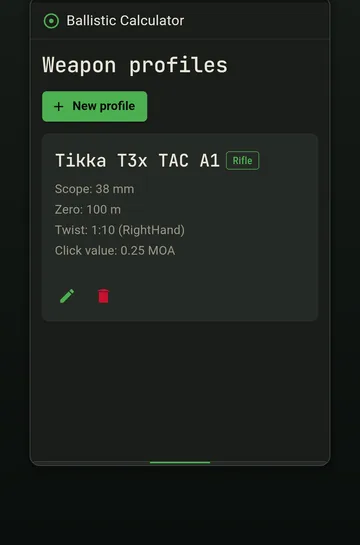
Zero distance, scope height above bore, barrel twist rate and direction, turret click value, and a default load. Stored per rifle and reused by the calculator, the DOPE card, the reticle view and the truing screen.
Reticle and DOPE
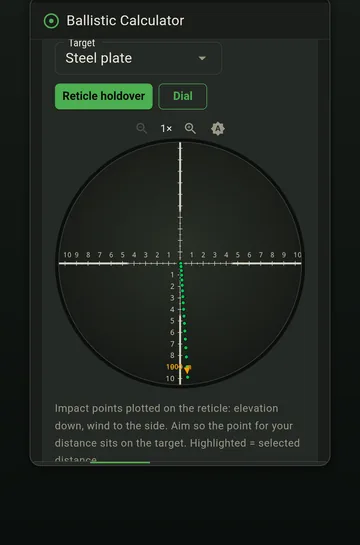
- Reticle holdover view — the solution drawn on a MIL or MOA grid, with plate and IPSC target overlays.
- DOPE card — a distance table for the day's conditions, exported as a shareable image.
- DOPE history — previously generated cards, so you can pull up the one you actually used.
- Output in MIL, MOA or clicks, switchable throughout.
Training journal
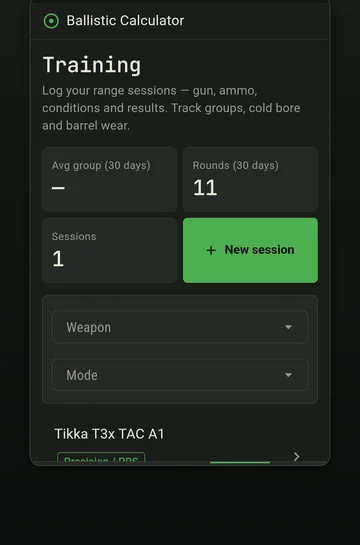
Three session types, each computing what that discipline actually measures:
| Mode | Records | Computes |
|---|---|---|
| Precision / PRS | Hits plotted on a target | Group size in cm and MOA, cold bore, velocity spread |
| IPSC / dynamic | Stage time and hit zones | Points and hit factor |
| Hunting | Distance and outcome | Retained energy at that distance |
Target presets cover ISSF 25/50 m, steel gongs of a size you specify, a fine measuring grid and free X/Y plotting. Sessions filter by rifle and by mode so the trend compares like with like.
Field tools
- Reticle ranging — target size and measured subtension in, distance out, with presets for common references. Sends the result straight to the calculator.
- Clinometer — shot angle from the phone's tilt sensors, with a tare for an uneven rest.
- Compass — magnetic azimuth for the Coriolis correction.
- Map picker — distance and bearing between two points, for targets you cannot laser.
Truing
Takes distances and the corrections that actually worked and solves for the input adjustment that reconciles them with the predicted trajectory — so you correct velocity or coefficient against evidence rather than moving a slider until it looks right.
Conditions
Temperature, station pressure, altitude and humidity, entered by hand or fetched for your position when you have a signal. Powder temperature is a separate input, because ammunition and air are frequently not the same temperature.
Practical
| Platform | Android, via Google Play |
| Price | Free — no subscription, no in-app purchases |
| Funding | one banner ad |
| Offline | Solver, database and profiles are all local |
| Account | None. No sign-up, no sync |
| Languages | 12 |
| Units | Metric and imperial throughout |
| Data | Stored on the device; Android backup can copy it to your Drive |
What it does not do
- No custom drag curves for individual bullets — G1 and G7 only.
- No Bluetooth link to a chronograph, weather meter or rangefinder.
- No cloud sync between devices, and no account to sync with.
- No competition timer, and no scoring against official match rules.
Frequently asked
Is any feature behind a paywall? +
No. There is no paid tier and no in-app purchase. Every screen listed on this page is available to everyone; a single banner ad funds the app.
Does it work offline? +
Yes. The solver, the ammunition database, your profiles and your sessions are all on the phone. Only the optional weather lookup needs a connection.
Will there be an iPhone version? +
There is no iOS version today and none announced. The app is Android only.
Put it in your range bag
Ballistic Calculator is free, works offline and runs the same point-mass solver on every screen you have just read about.