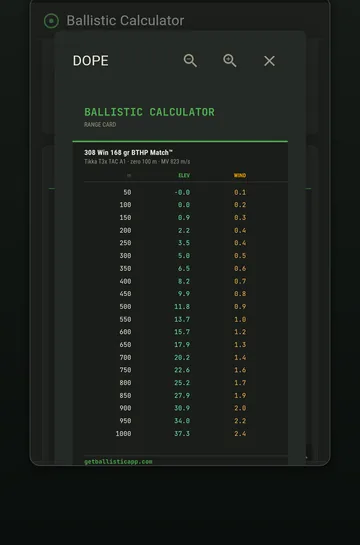
DOPE stands for data on previous engagements — corrections that have been confirmed by shooting rather than merely calculated. A generated card starts as a prediction and becomes DOPE once you have shot it and corrected it.
Generating the table
- Select the rifle and loadThe card belongs to that pair. A different load is a different card.
- Enter the day's conditionsTemperature, station pressure, altitude. These are what the card will be valid for.
- Set the distance range and step25 m steps for precision work inside 600 m; 50 or 100 m for a broader card. Small steps produce a long card that is slower to read.
- Choose a reference windA common approach is a 10 mph or 5 m/s full-value crosswind, so the windage column is a value you scale mentally rather than a single condition.
- Generate and reviewCheck the retained velocity column and note where the bullet stops being comfortably supersonic.
Exporting and sharing
The card exports as an image you can share through any app on the phone — messaging, email, or straight to a printer. The footer carries the site address, so a card passed to a squadmate tells them where it came from.
Two practical uses beyond your own pocket: sending a card to a spotter so you are both reading identical numbers, and printing one to tape to the stock as a backup for when the phone is flat or wet.
Labelling it so it is still useful in March
An unlabelled card is a trap. It looks authoritative and says nothing about when it applies.
- Rifle and load, including the ammunition lot if you track lots.
- Zero distance it was calculated from.
- Conditions: temperature, pressure, altitude. Or the density altitude if you think in those terms.
- Date, so you can tie it back to a session log.
- Whether it is calculated or confirmed — the most important label of all.
That last distinction matters more than shooters expect. A confirmed card is data. A calculated card is a hypothesis that has not yet met a target. Both are useful; treating one as the other is how people miss confidently.
How many cards do you need?
Run your solution twice — once with the coldest conditions you realistically shoot in, once with the hottest — and compare the corrections at your longest normal distance.
| Difference at your longest distance | What it means |
|---|---|
| Smaller than your target | One card covers your whole year |
| Comparable to your target height | Two cards: summer and winter |
| Larger than your target | Enter conditions per session; a static card will not do |
Most shooters working inside 600 m find one card is enough. Past 800 m, seasonal cards start to earn their keep. The mechanism behind this is in density altitude.
Keeping a history
Generated cards are saved in the app's DOPE history, so you can pull up the card you used at a given match rather than regenerating one and hoping the inputs match. When a card and a session log share a date, you have a complete record of what you predicted and what happened.
From calculated to confirmed
The path is the DOPE ladder: shoot the card at each distance, record what actually worked, then correct the inputs — not the card — using truing. Correcting the card alone fixes the distances you shot and leaves everything between them wrong.
Frequently asked
What distance step should I use? +
25 m inside 600 m for precision work, 50 or 100 m for a general card. Finer steps make a longer card that takes longer to read under pressure, which costs more than the interpolation saves.
Should the card include wind? +
Include a windage column for a reference crosswind — 10 mph or 5 m/s is conventional — so it scales. A card built for the current wind is out of date almost immediately.
Can I print it? +
Yes. Export the image and print it, or share it to any app that prints. A laminated card on the stock is the standard backup for a dead phone.