Enter a distance and conditions and the calculator returns a full row of numbers rather than just a correction. That is deliberate: the correction alone hides whether the shot is a comfortable one or right at the edge of what the model can predict.
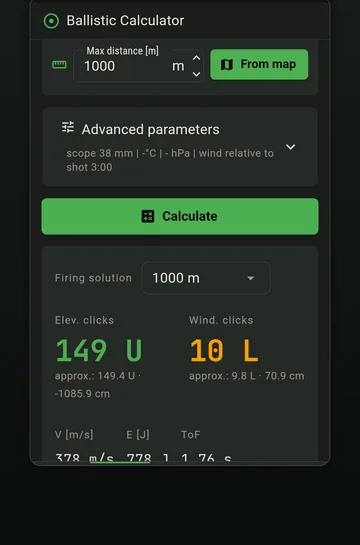
The two you act on
| Field | Meaning | How to use it |
|---|---|---|
| Elevation | Vertical correction from your zero | Dial it, or hold it on the reticle |
| Windage | Horizontal correction | Hold it. Dialling wind is for stable, known conditions only |
Both are shown in your chosen angular unit — MIL, MOA or clicks. If you have entered a click value in the rifle profile, the click count is the number you turn, with no arithmetic in the middle.
The windage figure already contains everything the app models horizontally: crosswind drift, spin drift, and Coriolis if you have it enabled. It is a total, not a wind-only number, which is why it can be non-zero in still air at long range.
The four you read
| Field | What it tells you |
|---|---|
| Retained velocity | How fast the bullet still is. The single best indicator of whether the prediction is reliable |
| Supersonic flag | Whether the bullet is still comfortably above the speed of sound at that distance |
| Energy | Terminal energy at impact. The number that matters for hunting |
| Time of flight | How long the bullet is exposed to wind, and how long a moving target has to move |
Retained velocity is the one worth building a habit around. When it approaches roughly 1.2 times the local speed of sound — about 410 m/s in standard conditions, and lower on a cold day — the bullet is entering the transonic region and the prediction should be treated as indicative rather than exact.
Entering conditions
- DistanceTyped, or brought in from the map tool or the reticle-ranging tool.
- Temperature and pressureStation pressure, not the sea-level-corrected figure from a forecast. Fetch them if you have a signal.
- Wind speed and clock positionThe hour is where the wind comes FROM. Twelve is a headwind; three is from your right and pushes the bullet left.
- Shot angle, if it is steepFrom the clinometer. Enter the angle and the true slope distance — never an already-corrected distance plus the angle.
Which corrections to leave on
Spin drift, Coriolis, cant and powder temperature are each switchable. The pragmatic setting is to leave them all enabled: each is small, none costs anything, and having them modelled separately keeps your recorded wind calls free of hidden constants.
The exception is cant. Enter a cant angle only if you know your position forces a consistent tilt. Random cant cannot be corrected by a number — it needs a bubble level and a routine.
Sanity checks before you shoot
- Does the elevation look like your rifle? If a familiar 500 m shot suddenly wants twice the usual correction, something in the inputs changed.
- Is the retained velocity plausible? A number far below what you expect usually means the coefficient or the model is wrong.
- Is the windage non-zero with no wind entered? That is spin drift and Coriolis, and at long range it should be.
- Does the distance match what you ranged? The commonest error of all is solving for the previous target.
Turning one solution into a card
A single solution answers one shot. For a session, generate a table across a range of distances and export it as a DOPE card — a card in your pocket beats a phone you have to wake, unlock and navigate with cold hands.
Frequently asked
Why is there windage when I entered no wind? +
Spin drift and Coriolis both produce horizontal deflection with no wind at all. At long range that total is real and worth applying.
Should I dial or hold? +
Dial elevation when the distance is known and stable; hold wind. Wind changes between shots and a held correction changes with it, whereas a dialled one has to be turned back.
The solution says the bullet is subsonic at my target. Can I still shoot? +
You can, but treat the prediction as approximate and confirm it with real impacts. The transonic transition is where solvers and bullets both behave least predictably.