Converting a numeric correction into a hold is a small mental operation that goes wrong under pressure — particularly for shooters who are new to a unit, or who are counting stadia in a hurry with an animal about to move. The reticle view removes the conversion.
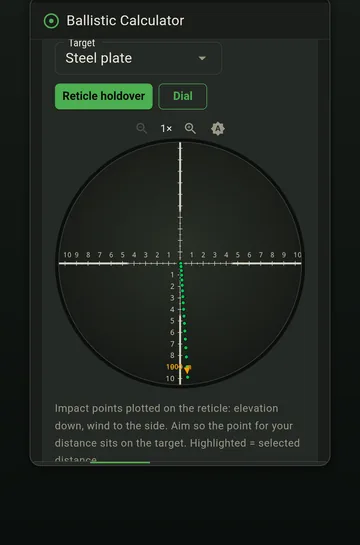
What the view shows
- The holdover point for the current solution, marked on the reticle.
- The windage offset applied at the same time, so you see the combined hold rather than two separate numbers.
- A target overlay — a plate or an IPSC silhouette — so the hold is shown in the context of what you are shooting at.
The last point is what makes it more than a novelty. A 1.2 MIL hold is abstract; a 1.2 MIL hold shown against an IPSC target immediately tells you whether the hold is still on the target or off it in space, which is a decision you have to make before you break the shot.
Hold or dial?
| Situation | Better approach | Why |
|---|---|---|
| Known distance, stable conditions | Dial elevation | Centre of the reticle on the target; nothing to remember |
| Wind, any distance | Hold | Wind changes between shots; a held correction changes with it |
| Multiple targets on a stage clock | Hold | No time to dial and return |
| Steep angle, one shot | Dial | You will not be repeating it |
| Mismatched reticle and turret units | Hold | Removes the conversion entirely |
That last row is worth restating. If your reticle is MIL and your turrets are MOA, holding is the fix: you measure a correction in the reticle and apply it in the reticle, and no conversion ever happens. The reasoning is in MOA vs MIL.
Using it well
- Solve firstDistance, conditions and wind entered. The view draws whatever the current solution is.
- Open the reticle viewConfirm the hold visually before you get behind the rifle.
- Count the stadia you will useNot the decimal value — the actual marks. 'Third line down, one to the left' is what you will execute.
- Check the hold is still on the targetA large holdover puts the aiming point in empty space above the target, which is much harder to hold consistently than a dialled centre hold.
- Break the shot without re-checking the phoneThe point of the view is that you memorise a picture, not a number.
Second focal plane scopes
A second-focal-plane reticle only subtends its stated values at one magnification, normally maximum. At any other setting the stadia mean something different, and a holdover measured in them is wrong by the ratio of the magnifications.
If you shoot a second-focal-plane scope, get into the habit of returning to the calibrated magnification before you hold. A first-focal-plane reticle is correct at every magnification, which is the main reason precision shooters prefer them.
Practising it
The view is most useful when you have already built the habit of thinking in reticle units. A useful drill: before each shot on a normal range session, predict the hold from memory, then check it against the app. Being consistently wrong in one direction is worth knowing about.
Under time pressure the skill is executing a memorised picture rather than reading a number — which is what the positional drill trains, with the clock running.
Frequently asked
Does the view match my specific reticle? +
It shows the solution on a generic MIL or MOA grid rather than reproducing every commercial reticle pattern. The subtensions are what matter, and those are standard within a unit.
Should I hold or dial for elevation? +
Dial when the distance is known and you have time; hold when you are on a clock or moving between targets. Wind is a hold in almost every case.
What if my holdover is larger than my reticle? +
Dial part of the elevation and hold the rest. Holding beyond the last stadium is estimating, and the estimate is unrepeatable.