The profile is where the app learns the geometry of your rifle. Everything downstream — the trajectory, the DOPE card, the reticle view, the truing screen — reads from it. Get it right once and you never think about it again.
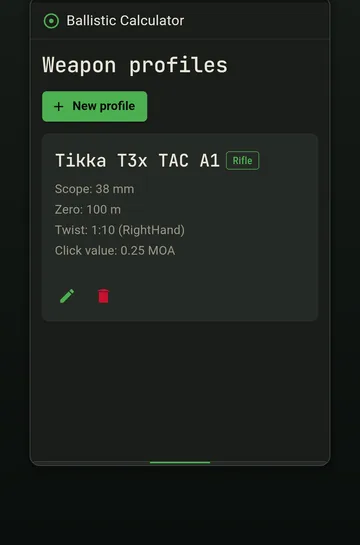
Zero distance
Enter the distance you actually confirmed the zero at, in the units you actually measured. This is the anchor for every calculated correction, so an error here is a constant offset on every line of your card.
If you have not confirmed a zero with at least five rounds, do that before you build the profile. The theory and the procedure are in zeroing.
Scope height
The distance between the bore centreline and the scope tube centreline. Neither centre is touchable, so measure surfaces and add the halves:
- Half the scope tube diameter15 mm for a 30 mm tube, 17 mm for a 34 mm tube.
- Plus the gapCaliper from the top of the barrel to the bottom of the tube, at the same station along the rifle.
- Plus half the barrel diameter at that pointMeasured, not from the catalogue — barrels taper.
- That sum is your scope heightTypically 38–50 mm on a bolt rifle, and 65–90 mm on an AR-pattern rifle with a high mount.
This input matters most at close range and at steep angles, and it skews reticle-ranging results. The full explanation is in scope height.
Twist rate and direction
Twist rate is usually stamped on the barrel or listed in the specification — 1:8, 1:10, 1:12. Enter the number after the colon.
Twist direction is nearly always right-hand, but the app asks because it decides which way spin drift goes. A left-hand barrel with the direction set wrong puts the correction on the wrong side, which doubles the error rather than merely omitting it.
| Twist | Typical use | Effect on the solution |
|---|---|---|
| 1:7 – 1:8 | Heavy-for-calibre match bullets | Higher stability, slightly more spin drift |
| 1:9 – 1:10 | General purpose | Balanced |
| 1:11 – 1:12 | Lighter bullets, older rifles | May not stabilise long bullets |
The app uses twist to derive a stability factor, which feeds the spin drift estimate. It cannot tell you whether a given bullet will stabilise in your barrel — that is a bullet-length question — but an honest twist figure keeps the drift estimate honest.
Click value
What one click of the elevation turret is worth: 0.1 MIL, ¼ MOA, ⅛ MOA, and so on. It is printed on the turret cap or in the manual.
This does not change the trajectory. It changes what the app hands you: with a correct click value it can express the correction as a number of clicks, which is the number you actually turn. With a wrong one it gives you a confidently wrong count.
Worth verifying rather than assuming: a box test at 100 m — dial a known number of clicks in a square and measure the sides — takes ten rounds and occasionally reveals that a turret does not move what it claims.
Default load
A profile can carry a default load so the calculator opens ready to solve. If a rifle sees two loads regularly — a match load and a hunting load — the fastest arrangement is usually two profiles rather than switching loads inside one.
Checking your profile is right
Three checks catch nearly every profile error, and all three are cheap:
- Solve for your zero distance. The elevation correction should be essentially zero. If it is not, the zero distance or its units are wrong.
- Solve for 25 m. The predicted impact should be a few centimetres low, roughly consistent with your scope height. A wildly wrong number here means the scope height is wrong.
- Solve for a distance you have real data for. Compare against what actually worked. A large mismatch at every distance points at the profile; a mismatch that grows with distance points at velocity or coefficient.
When to revisit it
- New scope or re-mounted rings — scope height and click value both change.
- New barrel — twist rate may differ, and the zero certainly does.
- Different ammunition — not a profile change, but a re-confirmed zero.
- A drop or hard transport — confirm the zero before trusting the profile again.
Frequently asked
Can I have several profiles for one rifle? +
Yes, and it is often the tidiest way to handle two loads or two zeros. Profiles are cheap; switching fields under time pressure is not.
What if I do not know my twist rate? +
Check the barrel markings, then the manufacturer's specification for your model and calibre. Failing both, it can be measured with a cleaning rod and a tight patch. Do not guess — it drives the spin drift estimate.
Does the click value affect the calculated trajectory? +
No. It converts the angular correction into turret clicks. A wrong value gives you the right angle expressed as the wrong number of clicks, which is arguably worse.